Philly Truce.
UX research on Philly Truce, a Philadelphia violence-prevention organization, examining what residents and Peace Patrol staff needed from its reporting system.
Scope
Client
Duration
Role

/
Where the research began
(01)
People needed to know how to report an incident, and what would happen after they did.
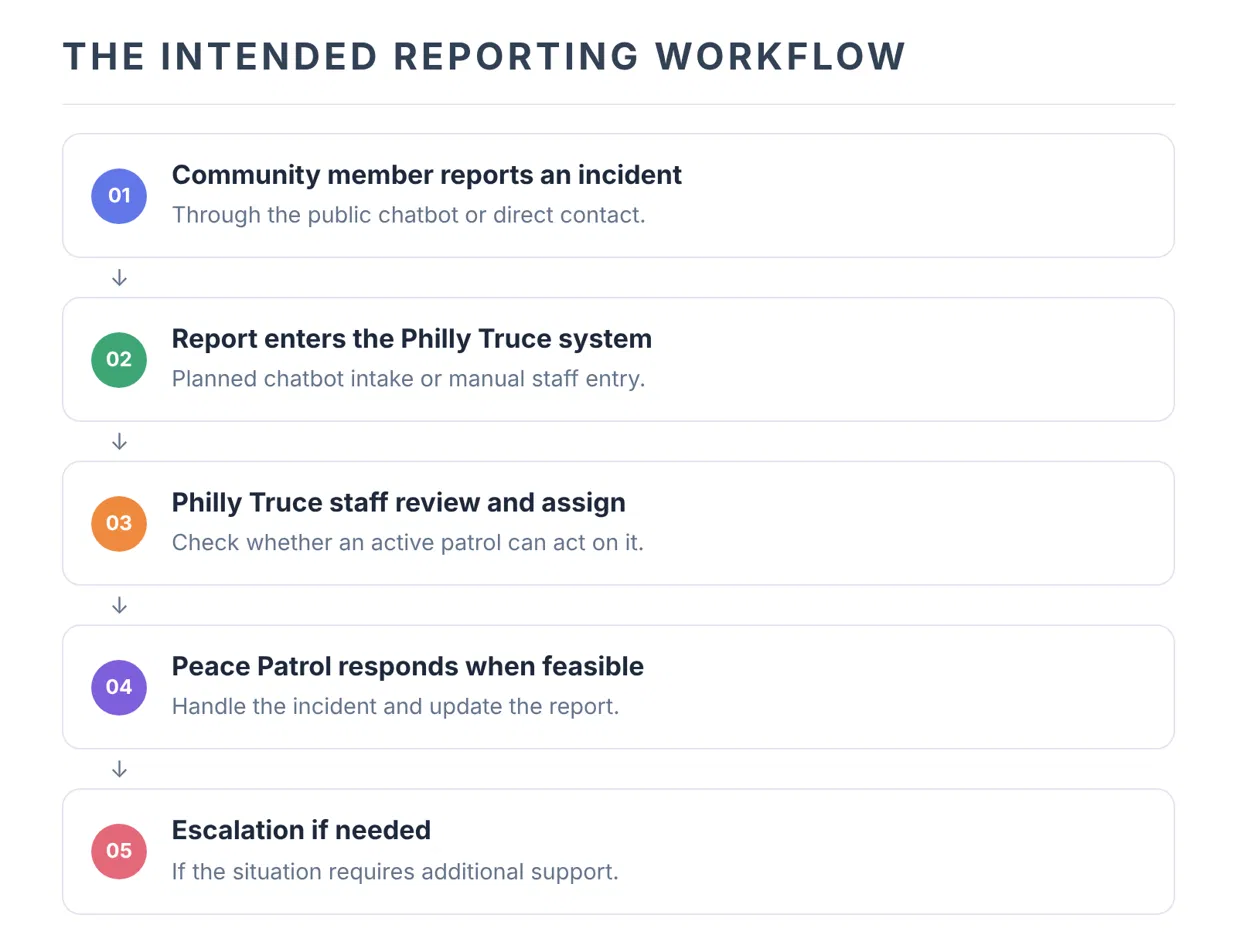
Philly Truce, a Philadelphia violence-prevention organization, was developing a system for residents to report safety concerns and for the organization to follow up. Residents could contact Philly Truce directly or use a public chatbot designed to turn their messages into reports in an internal reporting app.
There, patrollers from Peace Patrol, the organization’s community-led neighborhood patrol, could claim or be assigned reports and log incidents of their own. Philly Truce administrators could view the same reports from a desktop version. Whether a patrol could respond depended on who was available and whether patrollers could act on the report.
Our research traced each report’s path from submission to follow-up: who handled it, how patrollers and staff coordinated, and what residents could expect next. I co-led this work from study planning through final recommendations.
Our team began with seven exploratory interviews with residents, a patroller, and Philly Truce leadership, then ran three usability sessions in which two patrollers and an assistant program manager tried a prototype of the reporting app. I recommended this sequence so we could understand residents’ needs and Peace Patrol’s working context before evaluating the app with the people who would use it.

/
What the research revealed
(02)
The system did not always match how the work happened in practice.
Labels, filters, and report details
One participant read “PPD” as “Peace Patrol Director,” though it stood for “Philadelphia Police Department.” Participants also struggled to recognize the unlabeled filter icon. In the reporting app, patrollers could write reports themselves or receive reports to handle. The “Reports by me” filter was meant to show the reports assigned to them, but participants didn’t recognize that. One assumed, “I guess that those are the reports that I made.”
A participant also found “Fight” too vague because it could suggest a serious physical altercation. Participants wanted more context in report overviews, especially about threat severity and who else was involved or assigned.
Working in pairs and groups
The prototype allowed only one patroller to be assigned to each report, even though patrollers usually worked in pairs or groups. As one patroller put it, “It’s never just one.”
Trust and follow-up
Resident interviews raised concerns about anonymity and police involvement, along with a need to explain what happened after a report was submitted. Residents wanted transparency, while Philly Truce leadership and patrollers weighed how much to disclose against patrollers’ safety. How to communicate possible police involvement remained an open question for further study.


/
What the research recommended
(03)
Responsibility, status, and escalation needed to be easier to understand.
Each recommendation followed directly from these findings.
Labels, filters, and report details
We recommended spelling out “Philadelphia Police Department,” labeling the filter icon, and changing “Reports by me” to “Reports assigned to me.” We also recommended incident labels that distinguished levels of severity and more context in each report, including who else was involved or assigned.
Working in pairs and groups
We recommended allowing a report to be assigned to more than one patroller, reflecting how patrollers worked in pairs or groups.
Trust and follow-up
Beyond the interface, we recommended clearer communication about anonymity, what happens after a report is submitted, and how Philly Truce and Peace Patrol relate to the police, including when a report needs escalation. Because residents’ need for transparency had to be weighed against patroller safety, we also recommended further research on how to explain possible police involvement.
Philly Truce’s immediate priority was the reporting app, and our usability recommendations focused there. Still, our research pointed to a limit: interface changes alone might not address residents’ deeper trust concerns. We made that case to all project teams at the final sprint demo and in the research handoff for future phases.
The design team’s handoff listed our usability recommendations for the reporting app among its next steps.
The public chatbot was already in use, but the reporting app was still a prototype when our work ended. We did not measure whether our recommendations changed reporting or follow-up.
“Alex brings a strong anthropological lens to UX research. He consistently looks beyond technical usability issues to understand users in their broader social and environmental context. At his suggestion, we conducted exploratory interviews before usability testing, which helped us gain deeper insight into the lives and needs of our users in Philadelphia.”
Jihyang Jun, Co-Lead UX Researcher, Philly Truce (Tech Fleet)

